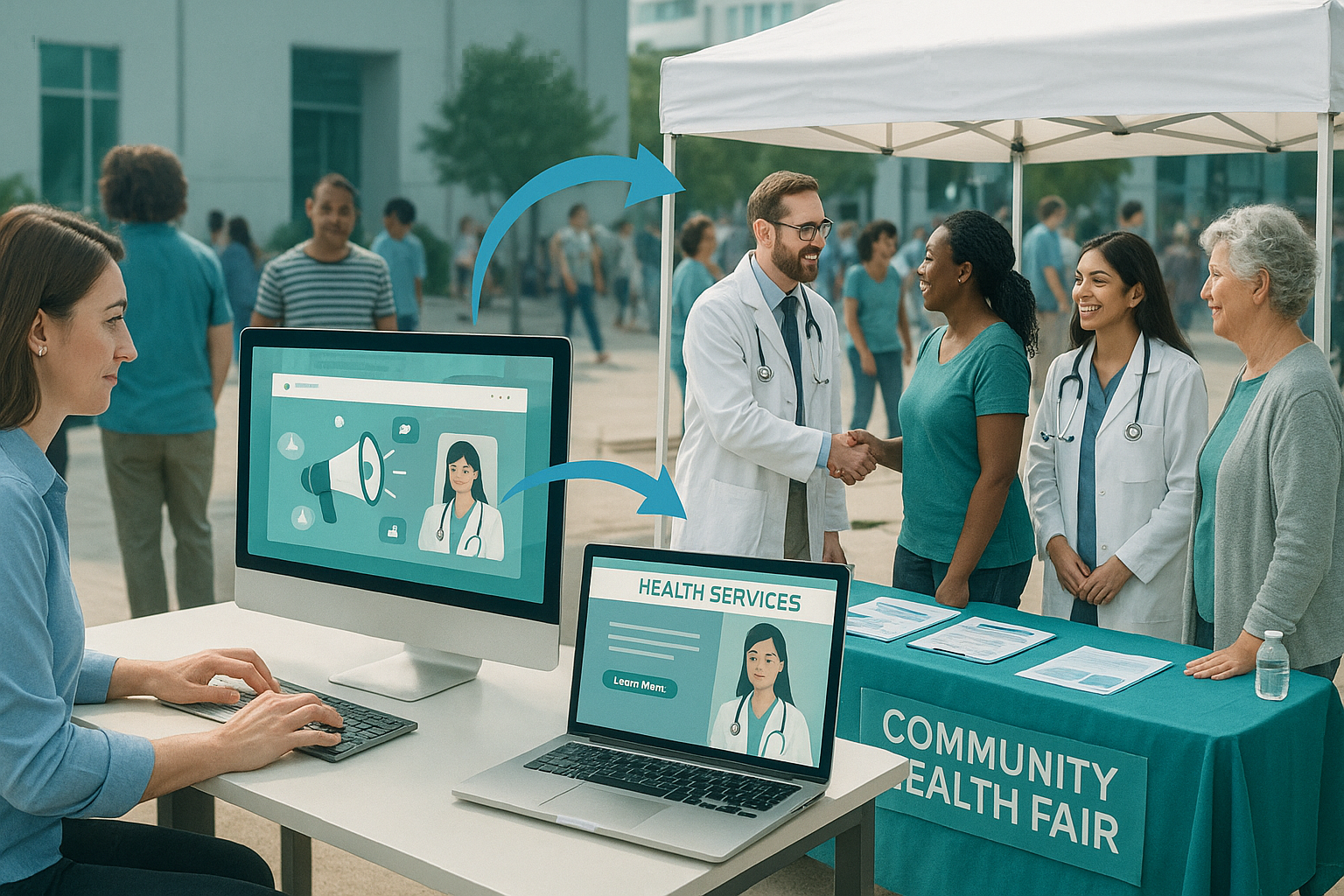
A hospital hosts a community health fair offering free screenings, wellness education, and health resources. Hundreds of community members attend, receiving valuable preventive care and information. It’s a successful event—but what happens when everyone goes home? Do these connections disappear, or do they continue growing?
Now imagine the same health fair amplified through strategic digital integration: Attendees pre-register online, receiving personalized event information. During the fair, they scan QR codes to download resources, sign up for email newsletters, and connect on social media. Post-event, they receive follow-up emails with their screening results, educational content relevant to their health concerns, and easy pathways to schedule appointments. The community event becomes not an isolated occurrence but the beginning of ongoing digital relationships that extend far beyond a single Saturday morning.
This is the power of integrating digital campaigns with community outreach programs. Mount Sinai Hospital’s “Healthy Community Challenge” invited residents to participate in wellness programs, offering free fitness classes and health screenings. The campaign also shared participant success stories via social media to inspire broader engagement. By combining physical presence with digital amplification, healthcare organizations create compounding value—deepening community connections while building scalable digital relationships.
This comprehensive guide explores how to strategically integrate digital campaigns with community outreach, creating synergistic programs that serve communities more effectively while driving measurable business outcomes.
Understanding the Integration Imperative
Before diving into tactics, we must understand why integration matters and what it achieves that isolated efforts cannot.
The Limitations of Siloed Approaches
Traditional community outreach programs—health fairs, educational seminars, free screening events—provide immediate value but often lack mechanisms for sustaining relationships beyond the event itself. You meet people, provide services, hand out pamphlets, and hope they remember you when healthcare needs arise. There’s no systematic follow-up, limited data capture, and difficulty measuring long-term impact.
Similarly, purely digital campaigns reach people efficiently and scale cost-effectively but often lack the personal connection, trust-building, and community embeddedness that physical presence creates. Digital campaigns can feel impersonal, struggle to reach digitally underserved populations, and miss opportunities to serve people where they actually live and gather.
Integration combines the strengths of both approaches while mitigating each’s weaknesses. Community outreach builds trust, demonstrates commitment, and creates personal connections. Digital campaigns scale that impact, sustain relationships over time, enable measurement, and facilitate ongoing engagement.
The Synergistic Value of Integration
When properly integrated, digital and community efforts create value greater than the sum of their parts:
Extended Reach: Community events attract people who wouldn’t encounter your digital content organically, while digital channels spread awareness of community programs far beyond physical attendance.
Sustained Engagement: One-time events become ongoing relationships through digital follow-up, education, and communication.
Data and Measurement: Digital integration enables tracking of community outreach impact—who attended, what services they accessed, whether they became patients, lifetime value generated.
Personalization at Scale: Digital systems allow personalized follow-up based on services accessed, interests expressed, and needs identified during community interactions.
Feedback Loops: Digital engagement reveals which community programs resonate most, informing future outreach strategy.
Addressing Health Equity Through Integration
Community-level efforts, such as health fairs or targeted screening events, can address structural barriers. Working with local nonprofits or churches fosters trust, making it easier for new patient groups to learn about your services.
Integrated approaches particularly benefit underserved populations. Community outreach meets people where they are, building trust with populations skeptical of healthcare institutions. Digital integration then sustains those relationships, providing ongoing education, resources, and care access pathways.
NYC Health + Hospitals ran a multilingual, multi-platform campaign that significantly increased preventive screenings in historically low-engagement neighborhoods. By combining targeted community outreach with digital follow-up in multiple languages, they reached populations traditional healthcare marketing misses.
Strategic Framework: Planning Integrated Campaigns
Successful integration requires upfront strategic planning, not retrofitting digital components onto existing community programs as an afterthought.
Defining Clear Objectives
Integration works best when both community and digital components serve unified goals. Begin by asking:
What are we trying to achieve?
Increase preventive care utilization in specific populations?
Build brand awareness in underserved communities?
Drive new patient acquisition?
Improve health outcomes for chronic conditions?
Address specific health equity gaps?
How will we measure success?
Event attendance numbers
Digital engagement metrics (email opens, social interactions, content consumption)
Healthcare utilization (appointments scheduled, screenings completed)
Health outcomes (vaccination rates, screenings results, condition management)
Long-term relationship development (patient retention, lifetime value)
What resources can we commit?
Budget for events, digital tools, and ongoing campaigns
Staff time for planning, execution, and follow-up
Technology infrastructure for data capture and digital engagement
Community partnerships and relationships
Audience Segmentation and Targeting
Not all community members have identical needs or digital behaviors. Segment audiences to tailor both outreach and digital strategies appropriately.
Segmentation Approaches:
Geographic: Target specific neighborhoods, ZIP codes, or communities based on health data, socioeconomic factors, or healthcare access gaps.
Demographic: Age, language, cultural background, and family structure influence both community program design and digital channel selection.
Health Status: Different approaches for healthy populations (prevention focus) versus those managing chronic conditions (disease management focus).
Digital Proficiency: Varying levels of digital literacy require different digital engagement strategies—from simple SMS for less tech-savvy segments to sophisticated app-based programs for digital natives.
Engagement Level: New community members need different outreach than established patients or long-term community partners.
Selecting Community Programs for Digital Integration
Some community outreach programs integrate more naturally with digital campaigns than others. Prioritize programs where integration adds substantial value.
High-Integration Potential Programs:
Health Fairs and Screening Events: Natural opportunities for data capture, digital sign-ups, and follow-up communications.
Educational Workshops and Seminars: Content can be recorded, repurposed digitally, and extended through online resources.
Wellness Challenges and Programs: Digital tracking, community boards, and ongoing engagement tools amplify effectiveness.
Support Groups: Combine in-person meetings with online communities, resources, and between-session support.
School and Workplace Partnerships: Natural settings for both physical events and digital engagement through existing communication channels.
Tactical Integration: Bringing Digital and Community Together
Strategic planning matters, but execution determines success. Here are proven tactics for integrating digital campaigns with community outreach.
Pre-Event Digital Activation
Integration begins before community events, using digital channels to drive awareness, facilitate planning, and build anticipation.
Pre-Event Digital Tactics:
Geo-Targeted Social Media Advertising: Promote community events to residents in target neighborhoods through Facebook, Instagram, and Nextdoor ads.
Email Campaigns: Send invitations to existing patients and community members in event areas, encouraging attendance and pre-registration.
Event Landing Pages: Create dedicated pages with event details, pre-registration forms, and resource downloads. Capture attendee information before they arrive.
Digital Partnerships: Collaborate with community organizations, schools, churches, and local influencers to share event information through their digital channels.
SMS Reminders: For pre-registered attendees, send text reminders as the event approaches.
Social Media Teasers: Build excitement through countdown posts, sneak peeks of activities, and introductions to speakers or healthcare providers attending.
A Texas hospital group launched “Neighbors in Care,” a campaign that provided free virtual seminars on managing chronic conditions like diabetes and hypertension, catering specifically to their local population’s health concerns. They used local digital channels to drive awareness and registration.
During-Event Digital Capture
The event itself presents the richest opportunity for digital integration, transforming brief in-person interactions into lasting digital relationships.
On-Site Digital Integration Tactics:
Digital Check-In: Use tablets or smartphones for event check-in, capturing contact information, health interests, and consent for follow-up communications. Make the process quick and frictionless.
QR Code Resource Distribution: Instead of (or in addition to) printed materials, provide QR codes linking to digital resources—downloadable guides, video content, appointment scheduling, newsletter sign-ups.
Social Media Engagement: Create event-specific hashtags, encourage attendee sharing with photo booths or interactive displays, and post real-time updates showing event energy and attendance.
Email/SMS Capture Stations: Dedicated stations where attendees can sign up for ongoing communication, health tips, or specific condition-related content series.
Interactive Kiosks: Digital displays where attendees can explore services, watch educational videos, complete health assessments, or schedule follow-up appointments.
Live Streaming: Broadcast key presentations or activities on Facebook Live, YouTube, or Instagram, extending reach beyond physical attendees.
Survey and Feedback Tools: Digital surveys (via tablet or QR code) capturing immediate feedback while information is fresh and gathering data on attendee needs and preferences.
Post-Event Digital Nurturing
The real integration power emerges after events, when digital channels sustain and deepen relationships initiated during community interactions.
Post-Event Digital Follow-Up:
Immediate Thank-You Emails: Send within 24-48 hours thanking attendees, recapping key information, providing links to resources discussed, and offering next steps (appointment scheduling, additional resources, upcoming events).
Screening Results Delivery: For health screenings, send results digitally through secure patient portals or email, accompanied by explanatory information and recommended follow-up actions.
Personalized Content Series: Based on services accessed or interests expressed at events, enroll attendees in targeted email series providing relevant health education, tips, and resources.
Social Media Community Building: Create or invite attendees to join Facebook groups, LinkedIn communities, or other social platforms where health discussions continue between events.
Retargeting Campaigns: Use event attendance data for digital ad retargeting, keeping your organization top-of-mind as attendees consider healthcare decisions.
Survey and Feedback: 1-2 weeks post-event, send surveys evaluating satisfaction, gathering suggestions for future events, and assessing health behavior changes resulting from event participation.
Appointment Scheduling Nudges: For attendees whose screenings indicated follow-up needs, send targeted reminders making appointment booking easy and convenient.
Platform and Technology Infrastructure
Effective integration requires appropriate technology stack enabling seamless data flow between community and digital touchpoints.
Essential Technology Components
Customer Relationship Management (CRM) System: Centralized database tracking all patient and community member interactions across channels. Advanced CRM platforms help healthcare organizations streamline operations and maintain meaningful patient connections.
Email Marketing Platform: HIPAA-compliant email system for newsletters, automated campaigns, and personalized communications. Integration with CRM enables segmentation and personalization.
Event Management Software: Tools for event registration, check-in, badge printing, and attendee tracking. Should integrate with CRM to transfer attendee data automatically.
Patient Portal: Secure platform for sharing screening results, educational resources, and facilitating appointment scheduling.
Mobile-Responsive Website: Event landing pages, resource libraries, and appointment booking must function flawlessly on smartphones.
Social Media Management Tools: Platforms like Hootsuite, Sprout Social, or Agorapulse for scheduling posts, monitoring engagement, and tracking hashtag performance across multiple social channels.
Analytics and Attribution Platform: System tracking how community event attendees engage with digital content, schedule appointments, and become long-term patients.
SMS/Text Messaging Platform: HIPAA-compliant text messaging for reminders, alerts, and brief communications. Particularly effective for hard-to-reach populations.
Data Integration and Flow
Technology only creates value when systems communicate effectively. Map data flow across your integrated campaigns:
Community Event Registration → Captured in event management system → Automatically synced to CRM
Event Check-In → Attendance recorded → CRM updated with participation data
Service Utilization (screenings, consultations) → Results documented → Available in patient portal and CRM
Interest/Preferences Expressed → Captured via surveys or intake forms → CRM tags for targeted follow-up
Digital Engagement (email opens, content downloads, social interactions) → Tracked in marketing platforms → Synced to CRM for complete view
Appointment Scheduling → Captured in EHR/practice management system → Linked to CRM for attribution
These systems integrate AI-driven insights, allowing providers to centralize patient data, track interactions, and personalize communication strategies.
Content Strategy for Integrated Campaigns
Content bridges community interactions and digital relationships, requiring careful planning for consistency and relevance across channels.
Repurposing Community Content Digitally
Community events generate rich content that can fuel digital engagement long after events conclude.
Content Repurposing Strategies:
Event Recordings: Record presentations, workshops, or Q&A sessions. Edit into digestible video segments for YouTube, social media, email newsletters, and website resource libraries.
Photo and Video Highlights: Event photos and short video clips become social media content, blog posts, email newsletter features, and promotional materials for future events.
Expert Q&A Compilations: Common questions from community events become FAQ blog posts, infographics, or video series addressing recurring concerns.
Success Stories and Testimonials: With proper authorization, attendee stories become powerful content across platforms—written testimonials, video interviews, social media features.
Infographics and Visual Summaries: Key health information shared at events becomes shareable infographics for social media and email distribution.
Downloadable Resources: Event handouts and presentations become PDFs, e-books, or interactive digital resources available long-term.
Creating Digital Content That Drives Community Participation
Conversely, digital content should actively promote and prepare people for community engagement opportunities.
Digital-to-Community Content:
Event Announcement Content: Blog posts, videos, and social media campaigns explaining what to expect, who will benefit, what to bring, and how to prepare.
Speaker/Staff Spotlights: Introduce healthcare providers and speakers who’ll participate in events, building familiarity and trust before in-person meetings.
Educational Pre-Event Series: Email or video series providing foundation knowledge on topics that will be covered at events, enabling more meaningful participation.
Community Needs Assessment: Digital surveys identifying health concerns and interests inform community program design, ensuring events address actual needs.
Behind-the-Scenes Content: Show event preparation, setup, and staff commitment through social media stories and posts, humanizing your organization.
Measuring Integrated Campaign Success
Data drives better ROI: Analytics and KPIs help optimize spend and improve patient acquisition. Measurement proves integration value and identifies optimization opportunities.
Community Metrics
Event Performance:
Total attendance numbers
Demographic breakdown of attendees
Services utilized (screenings, consultations, referrals)
First-time attendees versus returning participants
Geographic distribution of attendees
Immediate Impact:
Screenings completed and results
Referrals made to specialists or services
Educational materials distributed
Health assessments completed
On-site appointment scheduling
Digital Engagement Metrics
Online Reach and Awareness:
Social media impressions and engagement around events
Event landing page traffic
Email open and click-through rates for event promotions
Online event registrations
Post-Event Digital Activity:
Thank-you email open rates
Resource download rates
Website traffic from event attendees
Social media followers gained
Email list growth from event capture
Integration-Specific Metrics
These metrics specifically measure how well digital and community components work together:
Data Capture Rate: Percentage of event attendees whose contact information and preferences were successfully captured digitally.
Digital Opt-In Rate: Percentage of attendees consenting to ongoing digital communication.
Post-Event Engagement Rate: Percentage of attendees who engage with digital follow-up content (open emails, click links, download resources).
Conversion to Patient: Percentage of community event attendees who subsequently schedule appointments or utilize services.
Acquisition Cost: Total campaign cost divided by new patients acquired. Compare integrated campaigns to digital-only or community-only efforts.
Long-Term Value: Track lifetime value of patients acquired through integrated campaigns versus other channels.
Franciscan Health achieved $16.6M in revenue and onboard over 2,700 new patients through integrated tracking, demonstrating measurable business impact.
Attribution Modeling
Understanding which touchpoints contribute to patient acquisition requires sophisticated attribution:
Multi-Touch Attribution: Credit multiple interactions (community event attendance + email engagement + website visit) rather than only first or last touch.
Cohort Analysis: Track specific groups of event attendees over time, comparing their engagement and utilization patterns to non-attendees.
Survey Attribution: Ask new patients how they heard about your organization. Many will cite community events as key factors in choosing your services.
Real-World Success Stories
Theory matters, but demonstrated results prove the business case for integrated campaigns.
Mount Sinai: Healthy Community Challenge
Mount Sinai Hospital’s “Healthy Community Challenge” invited residents to participate in wellness programs, offering free fitness classes and health screenings. The campaign also shared participant success stories via social media to inspire broader engagement.
By integrating in-person wellness activities with social media storytelling and digital tracking, Mount Sinai created community accountability while building online awareness. Participants shared their progress digitally, creating viral momentum that attracted new participants while documenting program effectiveness.
PT Solutions: NFL Partnership
PT Solutions partnered with the Tampa Bay Buccaneers, capturing leads both online and in person at home games. They funneled prospects into a nurture series via the Cured by Innovaccer platform. Over two seasons, 12,116 messages were sent, achieving a 43.98% open rate.
This creative partnership demonstrated how community presence (NFL games) combined with sophisticated digital follow-up creates sustained engagement far beyond initial contact.
Carilion Clinic: #YESMAMM Campaign
Carilion Clinic’s #YESMAMM campaign integrated community-oriented communication with digital channels to drive mammography screening adoption. Community events provided education and on-site scheduling, while social media amplified messaging and created social proof through participant sharing.
The campaign’s adept integration of community-oriented communication and digital savvy demonstrated the profound influence that well-executed campaigns can have on public health behaviors.
Best Practices for Integration Success
Certain principles consistently separate successful integrated campaigns from failed attempts.
Start with Strategy, Not Tactics
Don’t begin by asking “How do we add digital to our health fair?” Start by asking “What are we trying to achieve, and how can integrated approaches serve those goals better than isolated efforts?”
Clear objectives, defined audiences, and thoughtful planning precede effective execution.
Ensure Seamless User Experience
Integration should feel natural to participants, not like disjointed components awkwardly combined. The transition from community event to digital engagement should be effortless.
Seamless Experience Elements:
Consistent branding across physical and digital touchpoints
Simple, intuitive digital interfaces (no complex logins or processes)
Clear value proposition for digital engagement
Immediate confirmation that digital actions succeeded
Rapid follow-up (within 24-48 hours) after community interactions
Respect Privacy and Build Trust
Community relationships depend on trust. Never abuse data collected during community outreach for aggressive marketing.
Trust-Building Practices:
Clear communication about how data will be used
Easy opt-in and opt-out mechanisms
HIPAA compliance for all health data
Transparency about organizational relationships and funding
Delivering on promises made during community events
Invest in Staff Training
Integration fails when front-line staff don’t understand their role in executing digital components.
Training Priorities:
How to use digital check-in and data capture tools
Explaining digital resources and how to access them
Encouraging social media engagement appropriately
HIPAA compliance in digital interactions
Troubleshooting basic technical issues
Iterate and Improve
First attempts at integration rarely achieve perfection. Build feedback loops, measure systematically, and continuously refine your approach.
Improvement Practices:
Post-event debriefs identifying what worked and what didn’t
A/B testing different digital follow-up strategies
Surveying both attendees and staff for improvement suggestions
Benchmarking against previous campaigns and industry standards
Sharing learnings across teams and departments
Overcoming Common Integration Challenges
Every organization faces obstacles when integrating digital campaigns with community outreach. Understanding common challenges and solutions accelerates success.
Challenge: Limited Technology Infrastructure
Problem: Existing systems don’t support sophisticated digital integration, data capture, or automated follow-up.
Solutions:
Start simple with manual data entry and basic email follow-up, demonstrating value before investing in advanced systems
Leverage free or low-cost tools (Google Forms, Mailchimp, social media) before enterprise platforms
Partner with digital health platforms offering integrated solutions
Build business case for technology investment using pilot program results
Challenge: Staff Resistance to Change
Problem: Community outreach staff comfortable with traditional approaches resist digital integration, viewing it as complicated or unnecessary.
Solutions:
Involve staff early in planning, incorporating their input and addressing concerns
Provide comprehensive training with ongoing support
Demonstrate how digital tools make their jobs easier (automated follow-up versus manual calls)
Celebrate early wins and staff champions
Start with voluntary pilots before organization-wide rollout
Challenge: Reaching Digitally Underserved Populations
Problem: Target communities have limited internet access, low digital literacy, or language barriers that complicate digital engagement.
Solutions:
Use SMS/text messaging (nearly universal) instead of requiring internet access
Provide digital access at community events (tablets, staff assistance)
Offer multilingual digital content and support
Accept that integration will look different for different populations—adapt strategies rather than abandoning integration
Partner with community organizations that already have digital connections with target populations
Challenge: Measuring ROI
Problem: Difficulty attributing new patients and revenue specifically to integrated campaigns versus other marketing efforts.
Solutions:
Implement tracking systems from the start (unique campaign codes, landing pages, registration sources)
Use CRM systems linking community interactions to subsequent healthcare utilization
Compare integrated campaign results to historical community-only or digital-only efforts
Track leading indicators (engagement, appointments scheduled) even when long-term revenue attribution is complex
Accept that some value (brand awareness, community goodwill) defies precise measurement
The Future of Integrated Healthcare Marketing
Several emerging trends will shape how healthcare organizations integrate digital and community approaches.
AI-Powered Personalization
AI enables hyper-personalized outreach and engagement, analyzing community interaction data to automatically trigger personalized digital follow-up based on services accessed, interests expressed, and predicted needs.
Virtual and Hybrid Community Events
The line between digital and community continues blurring. Future “community” events may offer both in-person and virtual attendance options, with digital platforms enabling participation regardless of physical location while maintaining community connection.
Mobile-First Integration
As smartphones become universal, mobile apps will serve as primary integration platforms—checking into events, accessing resources, scheduling appointments, tracking health metrics, and connecting with communities, all from a single interface.
Blockchain for Data Portability
Blockchain technology may eventually enable patients to control their own health data, carrying information captured during community screenings seamlessly across different healthcare systems and digital platforms.
Conclusion: Building Bridges Between Community and Digital
Healthcare has always been local and personal—relationships built through face-to-face interactions, trust earned through consistent presence in communities, and health improved through human connection. Digital technology hasn’t and shouldn’t replace these fundamental truths.
But digital tools can amplify community impact exponentially. They extend a Saturday morning health fair into year-round engagement. They transform brief screening interactions into lasting relationships. They scale the trust built through community presence across entire populations. They make every community touchpoint the beginning of ongoing support rather than an isolated encounter.
These campaigns emphasized the importance of community wellness and created a sense of belonging, positioning hospitals as accessible and reliable care providers. When digital integration is done thoughtfully, it enhances rather than replaces community connection.
The healthcare organizations that will thrive in coming years are those that refuse to choose between community presence and digital sophistication. They’ll build bridges connecting both worlds—bringing digital tools into community spaces while inviting community members into digital relationships. They’ll use technology not to distance themselves from communities but to deepen service and sustain connections impossible through sporadic physical presence alone.
Your community outreach programs already demonstrate your commitment to serving beyond clinic walls. Strategic digital integration multiplies that impact, creating relationships that improve individual health while building the community trust and loyalty that sustain healthcare organizations for generations.
The bridge between community and digital is waiting to be built. The question is whether you’ll build it before your competitors do—or whether you’ll watch them connect with your community in ways you haven’t yet imagined.
Ready to integrate digital campaigns with your community outreach programs? Our team specializes in creating seamless connections between community presence and digital engagement, helping healthcare organizations maximize impact while building sustainable patient relationships. From strategy development and technology implementation to campaign execution and measurement, we help you serve your community more effectively both in person and online. Contact us today for a complimentary integration assessment.
References
- Keragon. (2025). “5 Most Successful Healthcare Marketing Campaigns of 2025.” Retrieved from https://www.keragon.com/blog/healthcare-marketing-campaigns
- Digital Silk. (2025). “15 Healthcare Marketing Strategies For 2025 ROI.” Retrieved from https://www.digitalsilk.com/digital-trends/healthcare-marketing-strategies/
- Big Sea. (2025). “Top Healthcare Digital Marketing Trends in 2025.” Retrieved from https://bigsea.co/ideas/healthcare-digital-marketing/
- Beacon Health Marketing. (2025). “Top Healthcare Advertising Campaigns of 2025.” Retrieved from https://beaconhealthmarketing.com/top-healthcare-advertising-campaigns-of-2025/
- Flying V Group. (2024). “5 Examples Of Brilliant Healthcare Marketing Campaigns.” Retrieved from https://www.flyingvgroup.com/healthcare-marketing-campaigns/
- PR News. (2025). “Emerging Trends in Healthcare PR and Marketing.” Retrieved from https://www.odwyerpr.com/story/public/22781/2025-03-31/emerging-trends-healthcare-pr-marketing.html
- Tebra. (2025). “Everything You Need to Know for Effective Healthcare Marketing in 2025.” Retrieved from https://www.tebra.com/theintake/practice-growth/digital-marketing/healthcare-marketing-for-practices
- Cured Health. (2024). “2024: Healthcare Campaigns We Loved.” Retrieved from https://www.cured.health/resources/campaigns-we-loved-in-2024
- Brenton Way. (2024). “Biggest & Newest Healthcare Marketing Trends For 2024.” Retrieved from https://brentonway.com/healthcare-wellness-marketing-trends/
- PMC. (2025). “Integrating Digital Health Innovations to Achieve Universal Health Coverage.” Retrieved from https://pmc.ncbi.nlm.nih.gov/articles/PMC12071628/