Introduction
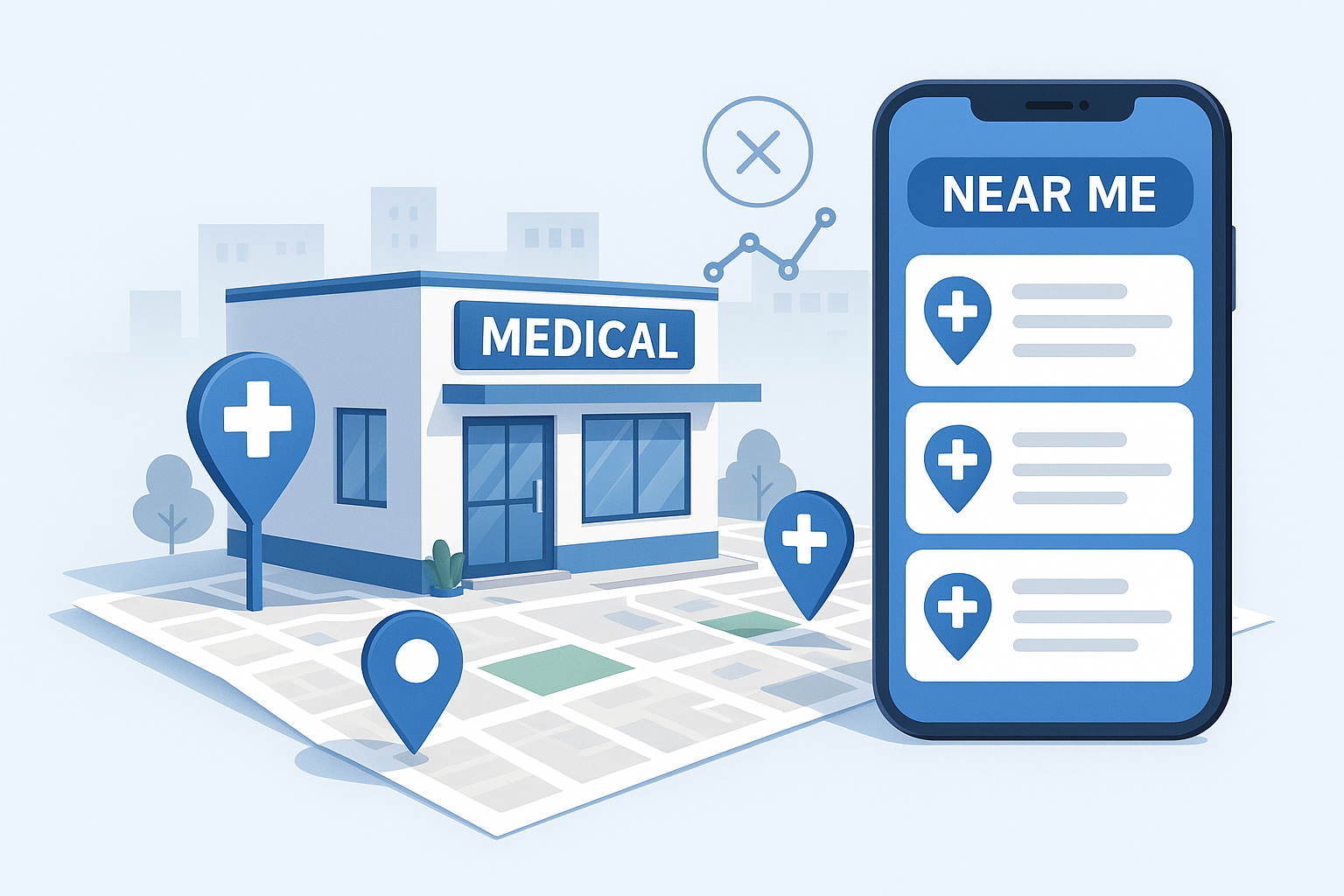
In the modern healthcare landscape, where over 77% of patients use search engines before booking a medical appointment, local search engine optimization (SEO) has evolved from a marketing luxury to an operational necessity. When a prospective patient searches for “pediatrician near me,” “urgent care open now,” or “orthopedic surgeon in [city name],” healthcare practices that have optimized their local SEO presence appear prominently in search results, while those that haven’t remain invisible to potential patients actively seeking their services.
Local SEO encompasses the strategies and tactics that help healthcare practices appear in geographically-relevant search results, Google Maps listings, and local business directories. For healthcare providers whose patients typically come from defined geographic areas—primary care physicians, dentists, physical therapists, urgent care centers, and specialty practices—local SEO directly impacts patient acquisition, appointment volume, and practice growth.
Despite its critical importance, many healthcare practices make fundamental local SEO mistakes that severely limit their online visibility and competitive positioning. These errors range from basic technical oversights like inconsistent business information across directories to strategic missteps like neglecting patient reviews or failing to optimize for mobile search. Many of these mistakes stem from healthcare providers’ unfamiliarity with SEO best practices, limited marketing resources, or outdated assumptions about how patients find healthcare providers.
This comprehensive guide identifies the most common and costly local SEO mistakes healthcare practices make and provides actionable strategies for avoiding them. Whether you operate a single-physician practice or manage marketing for a multi-location healthcare system, understanding and correcting these mistakes will significantly improve your local search visibility, patient acquisition, and competitive advantage in an increasingly digital healthcare marketplace.
Mistake #1: Incomplete or Inconsistent Google Business Profile
The Google Business Profile (formerly Google My Business) represents the single most important local SEO asset for healthcare practices. It powers your appearance in Google Maps, local search results, and the knowledge panel that appears when someone searches specifically for your practice. Despite its critical importance, incomplete or inconsistent Google Business Profiles rank among the most common and damaging local SEO mistakes.
The Problem
Many healthcare practices claim their Google Business Profile but never fully optimize it, leaving critical information fields empty or incomplete. Common deficiencies include missing business hours, absent descriptions of services, incomplete categories, few or no photos, and failure to add special attributes relevant to healthcare such as wheelchair accessibility, language services, or telemedicine availability.
Equally problematic is inconsistent information across your Google Business Profile and other online properties. If your website lists your address as “123 Main Street Suite 200” but your Google Business Profile shows “123 Main St. #200,” search engines interpret these as potentially different locations, creating confusion that harms your search rankings.
The Solution
Claim and fully optimize your Google Business Profile by completing every available field. Select your primary category with precision—”Family Medicine Clinic” rather than generic “Doctor”—and add all relevant secondary categories. Write a compelling business description that incorporates relevant keywords naturally while clearly communicating your services and differentiators. Upload high-quality photos of your practice exterior, waiting room, exam rooms, staff members, and medical equipment. Add your complete service list as individual offerings.
Ensure absolute consistency in your NAP (Name, Address, Phone number) across your Google Business Profile, website, and all online directories. Use identical formatting everywhere. If you abbreviate “Street” on your website, abbreviate it everywhere. If you include your suite number, include it consistently across all platforms.
Enable and configure all relevant Google Business Profile features including appointment booking links integrated with your scheduling system, direct messaging to allow prospective patients to contact you, service area specification if you provide home health services, and health and safety attributes particularly relevant post-pandemic.
Additional Considerations
For multi-location healthcare practices, create separate Google Business Profiles for each location. Never attempt to consolidate multiple locations under a single profile. Each location requires its own unique profile with location-specific information, photos, and management.
Monitor your Google Business Profile regularly for suggested edits from users or competitors. Google allows the public to suggest changes to business information, and these suggestions can sometimes introduce errors. Review and approve or reject suggested edits promptly to maintain accuracy.
Mistake #2: Ignoring or Mismanaging Online Reviews
Patient reviews exert enormous influence on local search rankings and patient decision-making. Google’s algorithm considers review quantity, review frequency, review ratings, and review responses when determining local search rankings. Simultaneously, research shows that 94% of patients use online reviews to evaluate healthcare providers, with positive reviews significantly increasing appointment bookings.
The Problem
Many healthcare practices make critical mistakes in review management. Some ignore reviews entirely, never responding to patient feedback whether positive or negative. Others respond only to negative reviews, creating an impression that positive feedback goes unappreciated. Some practices violate HIPAA by including protected health information in review responses or acknowledging patient relationships inappropriately.
Another common mistake is attempting to suppress negative reviews through intimidation or legal threats rather than addressing underlying patient concerns. Some practices discourage all reviews out of fear of negative feedback, missing the opportunity for positive reviews to enhance reputation and search rankings. A few unethical practices attempt to game the system through fake positive reviews or paying to remove negative reviews, practices that violate platform policies and can result in severe penalties.
The Solution
Develop a systematic review generation strategy that encourages satisfied patients to share their experiences. Train front desk staff to request reviews from patients who express satisfaction. Send follow-up emails after appointments with direct links to your Google Business Profile review page. Display signage in your office with QR codes that direct to review platforms. Make the review process as frictionless as possible by providing direct links rather than requiring patients to search for your business.
Respond promptly and professionally to all reviews, both positive and negative. Thank patients for positive reviews, acknowledging specific details they mention to demonstrate genuine engagement. For negative reviews, apologize for the patient’s negative experience without admitting fault or arguing, offer to discuss the issue privately by providing contact information, and explain any steps you’re taking to address systemic issues raised.
Critically, never include protected health information in review responses. Avoid acknowledging whether someone is or was a patient. Even seemingly innocuous statements like “We appreciate you choosing our practice for your care” can constitute HIPAA violations if they confirm a patient relationship. Instead, use responses that work for both patients and non-patients: “We appreciate you taking the time to share your feedback.”
Building a Review Strategy
Timing matters significantly in review requests. The optimal time to request reviews is shortly after positive interactions when patient satisfaction is highest. For primary care, request reviews a few days after appointments. For surgical specialties, wait until recovery progresses and outcomes become apparent. For dental practices, request reviews after routine cleanings rather than extensive procedures.
Diversify your review platform presence beyond Google. While Google reviews carry the most SEO weight, reviews on Healthgrades, Vitals, Zocdoc, Yelp, and Facebook also influence patient decisions and contribute to your overall online reputation. Create profiles on relevant healthcare review platforms and direct some patients to these platforms to build breadth of positive reviews.
Mistake #3: Poor Mobile Optimization
Mobile devices now account for the majority of local healthcare searches, with patients frequently searching for nearby care while experiencing symptoms or urgent needs. Google has implemented mobile-first indexing, meaning it predominantly uses the mobile version of websites for ranking and indexing. Despite this reality, many healthcare practice websites provide suboptimal mobile experiences that harm both user experience and search rankings.
The Problem
Common mobile optimization failures include non-responsive design where website elements don’t adapt to smaller screens, requiring users to pinch and zoom, tiny text that’s difficult to read on mobile devices, buttons and links too small or close together to tap accurately on touchscreens, slow page load speeds particularly problematic on cellular connections, intrusive interstitials or pop-ups that cover content on mobile devices, and forms that are cumbersome to complete on mobile devices.
These mobile usability issues directly impact local SEO rankings as Google penalizes sites with poor mobile experiences. More importantly, they cause prospective patients to abandon your website in frustration, often navigating immediately to better-optimized competitor sites.
The Solution
Implement responsive web design that automatically adapts to any screen size. Test your website thoroughly across various mobile devices and browsers. Use Google’s Mobile-Friendly Test tool to identify specific mobile usability issues and prioritize fixes.
Optimize mobile page speed through techniques including image compression and optimization, minimizing JavaScript and CSS, leveraging browser caching, enabling compression for text-based resources, and using a content delivery network (CDN) to serve content from geographically distributed servers.
Simplify mobile navigation by using hamburger menus or simplified navigation bars, making phone numbers immediately tappable with click-to-call functionality, positioning critical information like address, phone number, and hours prominently, ensuring buttons and tappable elements meet minimum size requirements, and streamlining forms for mobile completion with features like autofill and appropriate input types.
Mobile-Specific Features
Consider implementing mobile-specific features that enhance user experience and local SEO performance. Integrate maps directly into contact pages so patients can easily get directions. Implement text messaging for appointment reminders and confirmations. Enable GPS-based location services that help patients navigate to your practice. Optimize your patient portal for mobile access so patients can complete intake forms, view test results, and communicate with providers from smartphones.
Regularly audit mobile performance using tools like Google PageSpeed Insights, which provides specific recommendations for improving mobile load times and user experience. Monitor mobile traffic patterns in Google Analytics to understand how patients use your site on mobile devices and identify friction points where users abandon.
Mistake #4: Neglecting Local Keywords and Content
Healthcare practices often optimize websites for generic medical terms without incorporating the local geographic qualifiers that patients actually use when searching for nearby care. This oversight causes practices to miss significant local search traffic and rank poorly for searches with high patient intent.
The Problem
A cardiologist’s website might optimize extensively for “heart disease treatment” and “cardiac care” while neglecting terms patients actually use like “cardiologist in Portland,” “heart doctor near Pearl District,” or “cardiac specialist downtown Portland.” Without geographic qualifiers, the website competes nationally against major medical institutions, teaching hospitals, and healthcare publishers rather than ranking for local searches where competition is more manageable and patient intent is higher.
Many healthcare websites also lack location-specific content that signals relevance to local searches. Homepage content might discuss services generically without mentioning the cities, neighborhoods, or regions served. About pages fail to highlight community involvement or local partnerships that establish geographic relevance.
The Solution
Conduct comprehensive local keyword research to identify the geographic search terms patients use. Focus on keywords that combine your specialty or service with location modifiers including city names, neighborhood names, regional identifiers, “near me” variations, and proximity phrases.
Create location-specific service pages that target these keywords naturally. If you’re an orthodontist in Austin serving multiple neighborhoods, create individual pages optimizing for “orthodontist in Westlake,” “braces in Hyde Park,” “Invisalign downtown Austin,” etc. These pages should include unique, valuable content about serving each specific area, not just slight variations of template content.
Incorporate local keywords naturally throughout your website in page titles and meta descriptions, header tags (H1, H2, H3), body content where relevant, image alt text, and internal linking anchor text. Avoid keyword stuffing—use geographic terms where they make natural sense and provide value to readers.
Creating Location-Relevant Content
Develop content that demonstrates local expertise and community engagement. Write blog posts about local health issues, community health events you participate in, or partnerships with local organizations. Create resource pages listing local health resources, pharmacies, laboratories, imaging centers, or complementary services. Feature patient success stories from local community members with their permission.
For multi-location practices, develop location-specific landing pages for each office with unique content describing each location’s specific services, staff, specialties, parking information, public transportation access, and nearby landmarks. Include embedded Google Maps and photos of each specific location.
Mistake #5: Inconsistent NAP Citations Across Online Directories
NAP citations—listings of your practice Name, Address, and Phone number—appear across hundreds of online business directories, healthcare-specific platforms, and data aggregators. Consistency of this information across the web signals credibility to search engines and directly impacts local search rankings. Unfortunately, citation inconsistency ranks among the most common yet technically fixable local SEO mistakes.
The Problem
Healthcare practices often have inconsistent NAP information scattered across the internet due to several factors. Practices that have moved locations may have old addresses lingering on various directories they forgot to update. Phone number changes, website redesigns, or practice name modifications create inconsistencies when some directories are updated while others are overlooked. Multiple staff members managing different platforms may format information differently.
These inconsistencies confuse search engines trying to determine your practice’s correct information and reduce confidence in your location data. When Google finds your address listed as “123 Main Street” on some directories and “123 Main St.” on others, it may not confidently associate these listings with the same business, diluting the SEO value of your citations.
The Solution
First, audit your existing citations to identify where your practice is listed and what information each listing contains. Use citation checking tools like Moz Local, Whitespark Local Citation Finder, or BrightLocal to discover existing citations. Manually search for your practice name and variations to find additional listings.
Standardize your NAP information format and use it consistently everywhere. Make specific formatting decisions—abbreviate or spell out “Street,” include or exclude suite numbers, use or don’t use periods in abbreviations—and stick with those decisions universally. Document your standardized NAP format and ensure everyone managing online listings uses it exactly.
Claim and correct listings on major data aggregators that feed information to numerous other directories. Key data aggregators include Acxiom, Factual, Localeze, and Infogroup. Correcting information at the aggregator level cascades corrections to many downstream directories automatically.
Building and Managing Citations
Systematically build citations on high-quality, relevant directories. Prioritize general business directories like Google Business Profile, Bing Places, Apple Maps, and Yelp, healthcare-specific directories like Healthgrades, Vitals, WebMD, Zocdoc, and RateMDs, local business directories including chamber of commerce sites and local business associations, and industry-specific directories relevant to your specialty.
For each citation, complete your profile as fully as possible, including business description, hours, services, photos, and links to your website. More complete listings generally carry more SEO value than bare-bones citations.
Implement ongoing citation monitoring to catch and correct inconsistencies quickly. Set up Google Alerts for your practice name to discover new mentions. Schedule quarterly citation audits to verify accuracy across major directories. When you change location, phone number, or practice name, systematically update all citations rather than hoping old information eventually disappears.
Mistake #6: Failing to Optimize for Voice Search and “Near Me” Queries
The proliferation of voice-activated assistants and the increasing prevalence of mobile search have dramatically increased voice search usage, particularly for local healthcare queries. When patients ask Siri, “Where’s the nearest urgent care?” or tell Alexa, “Find a pediatrician near me,” they expect immediate, relevant results. Healthcare practices that haven’t optimized for voice search and “near me” queries miss substantial patient acquisition opportunities.
The Problem
Voice search queries differ significantly from typed searches in structure, length, and intent. Voice queries tend to be longer, more conversational, and phrased as questions. Typed search: “pediatrician downtown Seattle.” Voice search: “Who is the best pediatrician near me in downtown Seattle?” Many healthcare websites optimize for short, keyword-focused queries while neglecting the natural language patterns of voice search.
“Near me” searches have exploded in volume, increasing over 500% in recent years. These searches indicate extremely high intent—users want immediate information about nearby options and often convert to appointments quickly. Practices that don’t appear prominently for “near me” searches lose substantial patient volume to competitors who do.
The Solution
Optimize your Google Business Profile comprehensively, as this is the primary data source for voice search results and “near me” queries. Ensure your profile is complete, accurate, regularly updated, and includes your precise location information.
Create content that answers common questions patients ask using conversational, natural language. Develop FAQ pages addressing questions like “What should I bring to my first appointment?”, “Do you accept my insurance?”, “What are your hours?”, “Do you offer same-day appointments?”, and “Where are you located?” Structure these with clear questions as headers and concise answers in conversational language.
Incorporate long-tail conversational keywords throughout your site content. Rather than simply targeting “dermatologist,” optimize for phrases like “best dermatologist near me for acne treatment,” “dermatologist accepting new patients in [city],” or “where can I see a dermatologist today?” These longer phrases mirror how patients actually speak when using voice search.
Technical Optimization for Voice Search
Implement schema markup (structured data) to help search engines understand your content and deliver it accurately in voice search results. Key schema types for healthcare practices include LocalBusiness schema with complete NAP information and geographical coordinates, MedicalBusiness or specific healthcare business types, FAQPage schema for question-and-answer content, and Service schema describing specific treatments or services offered.
Optimize for featured snippets, which voice assistants often read as voice search results. Structure content to directly answer common questions in concise paragraphs of 40-60 words. Use bullet points and numbered lists where appropriate. Apply relevant header tags to questions.
Ensure your website loads quickly, as voice search results often prioritize fast-loading sites. Optimize for mobile since most voice searches occur on mobile devices. Focus on local relevance by mentioning your city, neighborhood, and surrounding areas naturally in content.
Mistake #7: Overlooking Online Reputation Beyond Reviews
While patient reviews receive significant attention in healthcare marketing, broader online reputation management often gets neglected. Healthcare practices’ online reputation extends well beyond review platforms to include social media presence, media mentions, healthcare quality ratings, accreditation information, and various online discussions about your practice. This broader digital footprint significantly influences both patient decisions and local search rankings.
The Problem
Many healthcare practices focus exclusively on review sites while their social media profiles remain inactive or outdated, their profiles on healthcare quality rating sites show incomplete information or lack patient ratings, mentions of their practice on local news sites, health forums, or social media go unmonitored and unaddressed, and negative information or outdated content ranks prominently in search results without any effort to address or counter it.
This neglect of broader online reputation creates multiple problems. Prospective patients researching your practice find incomplete, inconsistent, or negative information that undermines trust. Search engines lack positive signals about your practice’s authority and community engagement. Competitors with more active, comprehensive online presences outrank you in local search results.
The Solution
Develop a comprehensive online reputation management strategy that extends beyond review generation. Monitor mentions of your practice across the web using tools like Google Alerts for your practice name and provider names, social media monitoring tools to track mentions across platforms, reputation management software that aggregates mentions from multiple sources, and regular manual searches for your practice name, address, and provider names.
Maintain active, engaging social media profiles on platforms where your target patients spend time. For most healthcare practices, this includes Facebook for community engagement and practice updates, LinkedIn for professional networking and healthcare content, Instagram for visual content showcasing your practice and team, and potentially Twitter for health news and patient communication. Post regularly with valuable content, respond to comments and messages promptly, and use social platforms to build relationships with your local community.
Healthcare Quality Ratings and Directories
Claim and optimize profiles on healthcare quality rating sites including Healthgrades with its hospital quality ratings and patient satisfaction scores, Leapfrog Hospital Safety Grade if applicable, CMS Hospital Compare showing Medicare quality measures, and specialty-specific quality registries relevant to your practice. Complete all profile fields, encourage patients to rate quality measures, and highlight quality achievements prominently.
List your practice on comprehensive healthcare directories beyond basic citation sources. Identify directories specific to your specialty, insurance panels, hospital affiliations, and patient populations. Complete profiles thoroughly and keep them updated.
Content and PR for Reputation Management
Create authoritative content that establishes expertise and ranks well in search results for your practice name. Publish blog posts, participate in local media interviews, contribute guest articles to health publications, present at community health events, and develop partnerships with local organizations. This positive content pushes down any negative search results and provides substance for prospective patients researching your practice.
If negative content about your practice ranks prominently, address it appropriately rather than ignoring it. For legitimate complaints, acknowledge issues and explain corrective actions taken. For false or misleading information, consider reaching out to website operators to request corrections. For content that cannot be removed, create positive content to outrank it and provide context when appropriate.
Mistake #8: Not Creating Location-Specific Landing Pages for Multi-Location Practices
Healthcare organizations with multiple locations often make the critical error of treating all locations as a single entity from an SEO perspective. They create one set of service pages, one contact page listing all locations, and one set of content meant to serve all offices. This approach severely limits local search visibility for each specific location and creates confusion for both search engines and prospective patients.
The Problem
When a patient in Brooklyn searches for “orthopedic surgeon near me,” they want results for surgeons in Brooklyn, not a healthcare system with offices throughout New York that makes them figure out which location is closest. Search engines struggle to rank a multi-location practice appropriately for location-specific queries when the website doesn’t clearly differentiate between individual offices.
Generic “locations” pages that simply list addresses and phone numbers for all offices provide minimal SEO value. They don’t target location-specific keywords, don’t provide unique information about each location, and don’t give search engines strong signals about the relevance of each office to local searches.
The Solution
Create comprehensive, unique landing pages for each practice location. These pages should function as distinct presences optimized for the specific geographic area each office serves. Every location page should include a unique, optimized page title incorporating the location, a compelling H1 header with the location name, detailed address and contact information with click-to-call phone numbers, an embedded Google Map centered on that location, specific hours for that location, parking and transportation information, photos of that specific office exterior and interior, and unique written content about serving that specific community.
Critically, location pages must contain substantial unique content, not slight variations of template text. Describe what makes each location special—the providers who work there, services offered at that location, nearby landmarks or neighborhoods served, and community involvement specific to that area. This unique content signals to search engines that each page provides genuine value and deserves to rank for location-specific searches.
Technical Implementation
Implement proper technical SEO for location pages. Create a clear URL structure such as yourpractice.com/locations/brooklyn/ or yourpractice.com/manhattan-office/. Include location-specific schema markup on each page with accurate NAP information and geographic coordinates. Create separate Google Business Profiles for each location, linking each profile to its specific landing page rather than a generic homepage.
Build location-specific internal linking by linking from service pages to relevant location pages, creating “nearby services” sections on location pages that link to specific treatments, and building a clear site architecture that makes location pages easily discoverable. Ensure your main navigation provides easy access to all location pages.
Content Strategy for Multi-Location Practices
Develop location-specific content beyond basic landing pages. Create blog posts relevant to each community, announce location-specific events or promotions, feature providers at each location with individual bios, and showcase patient success stories from each community. This localized content strategy reinforces the connection between each practice location and its surrounding community while providing multiple pages that can rank for location-specific searches.
For healthcare systems with dozens or hundreds of locations, scale this approach through templates that enforce consistency while allowing location-specific customization. Assign responsibility for location page content to local practice managers who understand their communities and can create genuinely unique, relevant content.
Mistake #9: Ignoring Local Link Building Opportunities
Backlinks—links from other websites to your healthcare practice website—remain a critical factor in search engine rankings. For local SEO specifically, links from local websites, organizations, media outlets, and community institutions carry particular weight. Despite this, many healthcare practices neglect local link building, missing opportunities to improve both search rankings and community relationships.
The Problem
Healthcare practices often focus exclusively on clinical excellence while overlooking relationship-building with local organizations that could provide valuable backlinks. Their websites lack links from local newspapers, community organizations, chambers of commerce, health nonprofits, local universities, or other healthcare providers despite opportunities to earn these links through community involvement, expert commentary, or partnerships.
Without proactive link building, healthcare practice websites accumulate few quality backlinks, limiting their ability to rank competitively for local searches. Meanwhile, competitor practices with stronger local link profiles outrank them despite potentially providing equivalent or inferior clinical care.
The Solution
Develop a strategic local link building program focused on earning high-quality links from reputable local sources. Begin by identifying link opportunities including local media outlets that cover health topics, community organizations aligned with your mission, local universities or colleges with health programs, chambers of commerce and business associations, health-focused nonprofits and foundations, complementary healthcare providers for referral partnerships, and local event organizations and sponsors.
Earn links through genuine community engagement rather than manipulative tactics. Offer expert commentary to local reporters covering health stories. Sponsor local health fairs, charity runs, or community events that earn links from event websites. Participate in community health initiatives that generate coverage and links. Host educational seminars at local libraries, community centers, or senior centers. Partner with local nonprofits on health-related causes. Publish original health research or data about your community that earns media coverage.
Healthcare-Specific Link Building Strategies
Contribute guest posts to local health blogs, community news sites, or organizational newsletters. Write about health topics relevant to your local community without overtly promoting your practice. Include author bios with links to your website. Focus on providing genuine value rather than promotional content.
Develop partnerships with complementary healthcare providers for mutual referrals and website links. An orthodontist might partner with pediatric dentists, an orthopedic surgeon with physical therapists, or a dermatologist with medical spas. These referral relationships naturally generate backlinks while providing clinical value.
Create linkworthy resources specific to your local area. Develop comprehensive guides to healthcare resources in your city, directories of free or low-cost health services, health education materials in multiple languages spoken in your community, or original research about local health issues. Promote these resources to local organizations, media outlets, and community groups that might link to them.
Link Building Outreach Best Practices
When reaching out to request links or coverage, personalize communications and explain the mutual value. Don’t send generic template emails or engage in spammy link requests. Build genuine relationships before requesting links. Contribute value before asking for anything in return.
Monitor your backlink profile using tools like Google Search Console, Ahrefs, or Moz Link Explorer. Identify which sites link to you, what content attracts links, and opportunities to build similar links. Monitor competitor backlinks to discover link opportunities you’ve missed.
Disavow toxic links from spammy or low-quality sites that could harm your SEO. While most links help or are neutral, links from obviously manipulative link networks, foreign language spam sites, or sites with malicious content should be disavowed through Google Search Console.
Mistake #10: Failing to Track and Measure Local SEO Performance
Many healthcare practices invest time and resources in local SEO without establishing systems to measure results, understand what’s working, and identify opportunities for improvement. Without proper tracking and measurement, local SEO efforts operate blindly, wasting resources on ineffective tactics while missing high-impact opportunities.
The Problem
Healthcare practices often fail to track critical local SEO metrics including organic search traffic from local queries, rankings for target local keywords, Google Business Profile views and actions, phone calls and direction requests from search, conversion rates from local search traffic, and patient acquisition costs for SEO-driven patients. Without this data, they cannot determine ROI, optimize strategies, or justify continued investment.
Some practices rely on vanity metrics that don’t connect to business outcomes—total website visits without analyzing traffic sources or conversions, social media followers without engagement or conversion tracking, or search rankings for irrelevant keywords that don’t drive patient acquisition. These metrics may look impressive in reports but don’t indicate whether local SEO efforts actually generate new patients and revenue.
The Solution
Implement comprehensive analytics tracking for local SEO performance. Start with fundamental tools including Google Analytics 4 with proper configuration, goal tracking for key conversions, UTM parameters for campaign tracking, and geographic segmentation, Google Search Console for search query analysis, click-through rates, ranking positions, and indexing status, Google Business Profile Insights for profile views, search queries, actions taken, and direction requests, and call tracking software that attributes phone calls to specific marketing sources.
Define clear local SEO KPIs aligned with business objectives. Priority metrics should include organic traffic from local search queries, rankings for priority local keywords, Google Business Profile total views and search views, calls, direction requests, and website clicks from Google Business Profile, new patient appointments attributed to organic search, patient acquisition cost for SEO channel, and conversion rate from local search traffic to appointment requests.
Building a Measurement Framework
Create a structured reporting system that tracks performance over time and identifies trends. Establish baseline metrics before implementing SEO changes so you can measure improvement. Set specific, measurable goals for each metric. Review performance monthly or quarterly with stakeholders and adjust strategies based on data insights.
Implement conversion tracking for key patient actions including appointment request form submissions, phone calls to the office, clicks on driving directions, patient portal registrations, and email inquiries. Use Google Analytics goals, Google Ads conversion tracking, or dedicated call tracking platforms to capture these conversions.
Conduct regular local search ranking audits to monitor your positions for target keywords. Track rankings on both desktop and mobile since they can differ. Monitor rankings across different locations within your service area. Pay particular attention to “near me” searches and location-qualified keywords with high patient intent.
Competitive Analysis and Benchmarking
Monitor competitor local SEO performance to benchmark your progress and identify opportunities. Track competitor rankings for shared keywords, review their Google Business Profiles for engagement and reviews, analyze their backlink profiles for link opportunities you’ve missed, and monitor their content strategies for topics and formats that generate engagement.
Use competitive insights to inform your strategy. If competitors rank well for keywords you’re targeting, analyze their pages to understand why. If they have successful content, create superior content on similar topics. If they’ve earned quality backlinks, pursue similar opportunities.
Regularly audit your own local SEO implementation to identify technical issues or optimization opportunities. Check for broken links, duplicate content, mobile usability problems, slow page speeds, citation inconsistencies, or missing schema markup. Use SEO audit tools combined with manual checks to comprehensively evaluate your local search presence.
Implementing a Local SEO Improvement Plan
Understanding these common mistakes provides a foundation, but sustainable improvement requires systematic implementation of solutions. Healthcare practices should approach local SEO strategically, prioritizing high-impact improvements while building long-term optimization capabilities.
Prioritizing Improvements
Begin by auditing your current local SEO against the mistakes outlined in this guide. Identify which problems affect your practice most significantly. Prioritize improvements based on potential impact and implementation difficulty. Quick wins—high impact, relatively easy fixes—should be addressed first to generate momentum and demonstrate value.
For most healthcare practices, priority improvements include claiming and fully optimizing Google Business Profile, achieving consistent NAP citations across major directories, implementing comprehensive mobile optimization, establishing systematic review generation and response, and creating location-specific landing pages for multi-location practices.
Building Internal Capabilities
Local SEO requires ongoing attention rather than one-time implementation. Build internal capabilities by assigning clear responsibility for local SEO management, providing training on SEO best practices, establishing workflows for routine optimization tasks, implementing quality control processes, and scheduling regular audits and performance reviews.
For smaller practices with limited marketing staff, consider whether to develop internal expertise, hire local SEO specialists or agencies, or employ a hybrid approach combining internal coordination with external expertise. Each approach has tradeoffs between cost, control, and effectiveness that depend on your specific circumstances.
Staying Current with Local SEO Evolution
Local SEO evolves continuously as search engines update algorithms, user behavior shifts, and new technologies emerge. Stay current through reputable SEO industry publications, Google’s official webmaster blog and guidance, local SEO conferences and webinars, professional associations and peer learning groups, and consultations with SEO specialists who maintain current expertise.
Allocate time and resources for ongoing optimization rather than treating local SEO as a completed project. Schedule quarterly reviews of local SEO performance, emerging opportunities, algorithm updates affecting healthcare search, and competitive landscape changes.
Conclusion
Local SEO represents a critical channel for patient acquisition that healthcare practices cannot afford to neglect or mismanage. The mistakes outlined in this guide—from incomplete Google Business Profiles and inconsistent citations to mobile optimization failures and inadequate measurement—limit online visibility, reduce patient acquisition, and hand competitive advantages to more strategically-minded practices.
The encouraging reality is that most local SEO mistakes are entirely correctable through systematic attention, strategic implementation, and ongoing optimization. Healthcare practices that commit to local SEO excellence gain substantial competitive advantages including higher search rankings that increase online visibility, more patient inquiries and appointment bookings, reduced patient acquisition costs compared to paid advertising, stronger local reputation and community presence, and sustainable growth driven by organic search visibility.
The path forward requires honest assessment of current local SEO performance, strategic prioritization of improvement opportunities, systematic implementation of best practices, and commitment to ongoing optimization and measurement. Healthcare practices that follow this path will find that local SEO delivers among the highest returns on investment of any marketing channel—connecting patients who actively seek your services with your practice at precisely the moment they need care.
In an increasingly digital healthcare marketplace where the journey from symptoms to appointment often begins with a local search query, excellence in local SEO is no longer optional but essential to practice growth, patient access, and community health impact. The healthcare practices that recognize this reality and commit to avoiding the common mistakes outlined here will position themselves for sustained success in serving their communities and growing their practices.
References
- BrightLocal. (2024). “Local Consumer Review Survey: Healthcare Edition.” https://www.brightlocal.com/research/
- Google. (2023). “How People Search for Healthcare Information.” Google Health Search Insights.
- Moz. (2024). “Local Search Ranking Factors Study.” https://moz.com/local-search-ranking-factors
- Pew Research Center. (2024). “Mobile Technology and Health.” https://www.pewresearch.org/internet/
- Search Engine Journal. (2024). “Voice Search Statistics and Trends.” https://www.searchenginejournal.com/
- Sterling Research & Strategy. (2023). “Local Search Usage Study.”
- Software Advice. (2024). “Patient Perspectives on Healthcare Providers’ Online Presence.”
- BrightEdge. (2024). “Organic Search Statistics: Healthcare Industry Benchmark Report.”
- ReviewTrackers. (2023). “Online Reviews Statistics and Trends for Healthcare.”
- Think with Google. (2024). “How Mobile Search Behavior is Changing Healthcare.” https://www.thinkwithgoogle.com/
- Healthgrades. (2024). “Patients’ Perspectives: How Americans Find and Choose Healthcare Providers.”
- Semrush. (2024). “Local SEO Success Factors: Healthcare Industry Analysis.” https://www.semrush.com/
- American Medical Association. (2023). “Digital Marketing Best Practices for Medical Practices.” https://www.ama-assn.org/
- Healthcare Information and Management Systems Society (HIMSS). (2024). “Digital Patient Engagement Trends.”